

Rapid building assessment placarding system
Last updated: 24 September 2026
The rapid building assessment system includes 'placarding' buildings.
Placards indicate whether or how a building may be used. There are three placard colours. When a Rapid Building Assessor makes a judgement on the usability of a building, they are required to outline this on the placard they choose to use.
Rapid assessment placards
Placards are sometimes referred to as stickers, signs or notices. MBIE uses the term placards.
The different coloured placards let you know what the next step is.
Visual
Aerial view of a city.
Text on screen:
- Building Performance
- Ministry of Business, Innovation and Employment, Hīkina Whakatutuki
Scenes of residential neighbourhood.
Icons on screen:
- Flooding
- Earthquake
- Fire
Audio
Significant weather events and natural disasters can leave homeowners feeling vulnerable and uncertain about the safety of their homes.
Visual
Aerial view of a city.
Text on screen: MBIE's Building Performance team provides stewardship of building management in emergencies.
Audio
As the central regulator of building systems in Aotearoa New Zealand, the Ministry of Business, Innovation and Employment oversees the management of buildings in emergencies.
Visual
Close up of a man and a woman wearing hi-vis jackets and hard hats walking on a residential street, meeting a woman outside a residential house.
Group stand on pavement outside house and point to building.
Audio
and supports local councils to manage buildings in their area that might have been damaged.
When buildings are damaged, Rapid Building Assessments are carried out where a state of emergency or designation is in place.
Visual
Exterior of house.
Text on screen: Rapid Building Assessments are facilitated by the local council.
Group stand and point to different areas of the exterior of the house, discussing the building.
Close up of person completing a rapid building assessment placard on a clipboard.
Woman wearing hi-vis and hardhat fixes completed placard to the exterior of the building
Audio
Rapid Building Assessments are facilitated by the local council and are a quick visual inspection of a building or surrounding property to assess the risk against safety and life. Qualified Rapid Building Assessors – or R-B-As – complete an assessment and depending on the extent of the damage or hazard identified, they may affix a placard to the building reflecting the outcome of their assessment.
Visual
Exterior of house in background.
Images showing red, yellow and white placards appear on screen.
Audio
Placards are either red, yellow or white.
Visual
Person holding clipboard in background.
Image showing a white placard.
Text on screen: The building can be used, but it does not mean that the building is not damaged.
Audio
A white placard means your building can be used, but it does not mean that the building is not damaged.
Visual
Residential street with houses and traffic.
Icon: Tick.
Text on screen: Not reasonably necessary to prohibit of restrict the use of the building to remove or reduce risks of injury or death.
Audio
It means the RBA has assessed that it is not reasonably necessary to prohibit or restrict the use of the building to remove or reduce risks of injury or death.
Visual
Person holding clipboard in background.
Images showing 2 yellow placards.
Text on screen: The building can be used, but it does not signify that it is completely safe.
Audio
A yellow placard means that the building only has restricted access.
Visual
Residential street at sunset, changes to group standing outside house discussing a yellow placard.
Text on screen: Due to damage or identified risks, only certain parts of the building can be entered and used.
Audio
A yellow placard restricting access to parts of a building means that due to damage or identified risks, only certain parts of the building can be entered and used.
Visual
Drawing showing a floorplan of a simple building with a tree outside. The tree is damaged and falls over damaging part of the house. The area affected is shown with red hatching.
Audio
A good example of this is a living room in a house might have suffered damage to an entryway because of a tree falling on it.
Visual
Drawing showing a floorplan of a simple building that has been damaged by a falling tree. The area affected is shown with red hatching. A yellow placard is shown being completed to confirm the areas affected by the damage.
Audio
The placard will specify that the living room, and adjacent affected areas of the house, cannot be used, but the kitchen, bathrooms and bedrooms might be ok.
Visual
Person holding clipboard in background, changes to image of person in a building.
Image showing a yellow placard.
Text on screen: Access to the building is only allowed for a short time, to gather essential documents for example.
Audio
A yellow short-term entry placard means that access to the building is only allowed for a short time, to gather essential documents for example.
Visual
A living room inside a house, changes to a shot of someone fixing yellow barrier tape across a doorway.
Text on screen: The placard will specify if access needs to be supervised by a person authorised by the issuing authority (generally your local council).
Audio
The placard will specify if access needs to be supervised by a person authorised by the issuing authority.
Visual
Person holding clipboard in background while writing on a form.
Image showing two red placards.
Text on screen: The building is unsafe and must not be entered.
Audio
A red placard means the building is unsafe and must not be entered,
Visual
Drawing showing a floorplan of a simple building with damage indicated to part of the building.
The damage is indicated by red hatching inside the house, affecting whole house; this changes to red hatching surrounding the house showing an external hazard.
Text on screen: Because of significant building damage or because the building is at risk from an external hazard.
Audio
either because of significant building damage or because the building is at risk from an external hazard.
Visual
Residential street.
Image showing two red placards.
Text on screen: A red placard doesn’t always mean that a building needs to be demolished.
Audio
A red placard doesn’t always mean that a building needs to be demolished.
Visual
Residential street.
Image showing a red placard and a yellow placard.
Audio
If a building has a red or yellow placard you must follow the instructions on the placard about whether and how it can be occupied or used.
Visual
Exterior of a two storey residential house.
Icons: yellow placard being damaged, altered and removed.
Audio
You also cannot intentionally damage, alter, or remove the placard.
Visual
Aerial view of a city.
Text on screen: Once your building has been assessed, you can contact your local council for more information.
Audio
Once your building has been assessed, you can contact your local council for more information.
Visual
Women using cell phone.
Text on screen: Contact your insurer or landlord, because they should advise you of what steps to take next.
Audio
It's important to contact your insurer or landlord, because they should be able to advise you of what steps to take next.
Visual
Aerial image of a city.
Image in foreground showing the www.building.govt.nz webpage.
Audio
M-B-I-E has developed comprehensive guidance for home-and building owners to provide information when they need it the most.
Emergency Management Act 2026
The Emergency Management Act 2026 (EM Act) commenced on 4 September 2026, replacing the Civil Defence Emergency Management (CDEM) Act 2002.
Placards have been updated to reflect these changes. Note that if you see references to the CDEM Act in other information, these should generally be read as references to the equivalent provisions in the EM Act. This helps ensure existing guidance and information continue to apply during the transition.
Red placard
A red placard means entry is prohibited. Your building may pose a significant risk to public safety, health, and wellbeing. The risk could be from the building itself, from adjacent buildings or from land instability.
It does not necessarily mean the building will need to be demolished.
There are two classifications with a red placard:
- R1 specifies that the building structure has been visually inspected and found to be seriously damaged and/or unsafe to occupy.
- R2 specifies that the building is at risk of being affected by an external hazard and the building is unsafe to occupy.
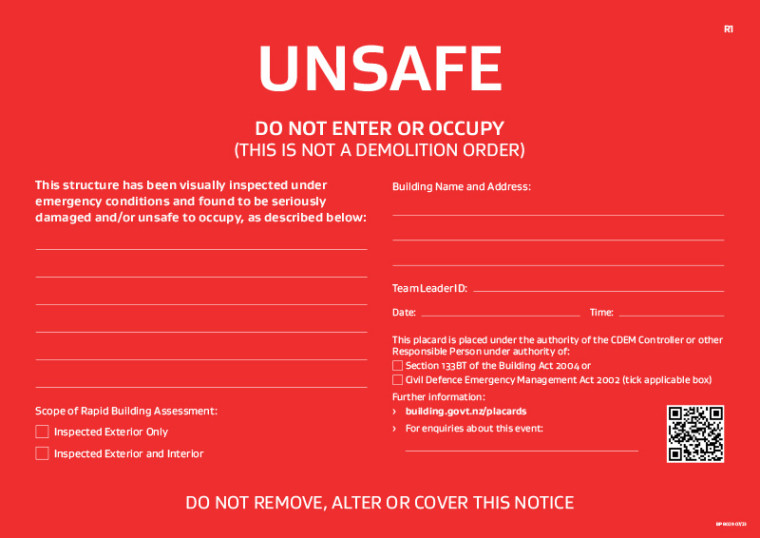
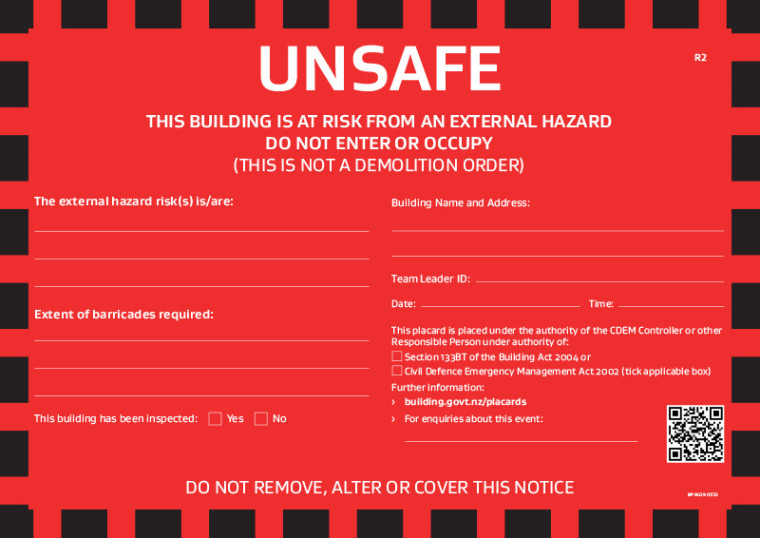
View the R1 & R2 red placards [PDF 158KB]
Yellow placard
A yellow placard means that access to your building is restricted and cannot be used or that you cannot enter except under supervision for a limited time or on essential business. Part or all the building may have sustained moderate damage, or some areas of the building, neighbouring buildings, or land instability pose a significant risk.
There are two classifications with a yellow placard.
- The Y1 placard specifies restricted access to parts of the building only. This means that parts of the building have sustained damage or are at risk from external hazards.
- The Y2 placard specifies that access to the building is allowed on a short-term basis only, with supervision.
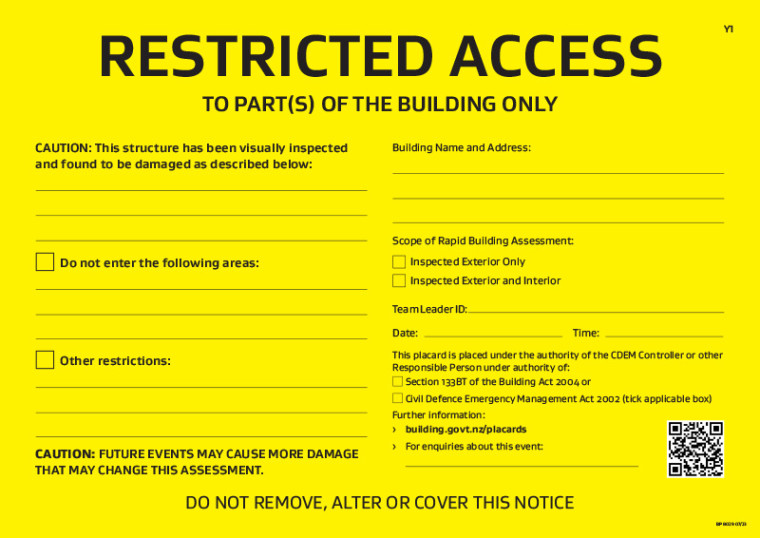
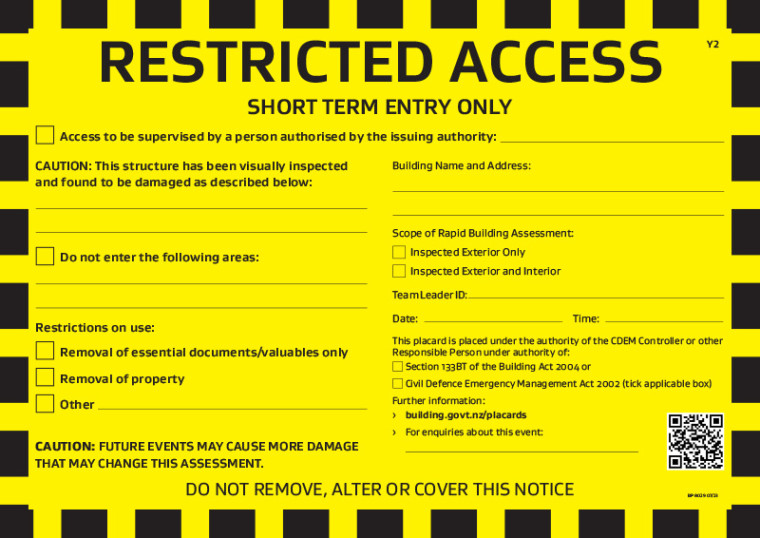
View the Y1 & Y2 yellow placards [PDF 195KB]
White placard
A white placard means that your building can be occupied. It does not mean that the building is not damaged. Be on the lookout for damage and contact your landlord or rental manager if you rent your home.
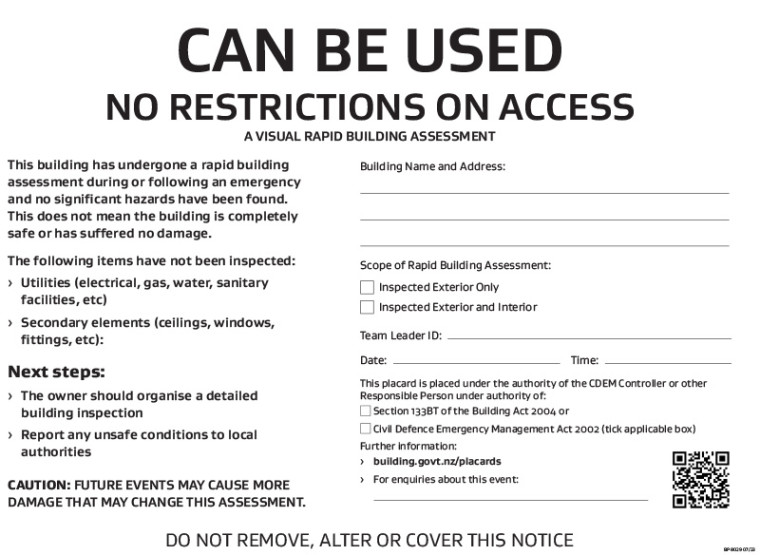
View the white placard [PDF 121KB]
Information for homeowners and occupiers
The following information for homeowners that explains what to do if your home or building has a rapid assessment placard, and what the placards mean.
Information for homeowners and occupiers: What should you do after an emergency? [PDF 486KB]
More information about the different placards
If your home or building is undamaged, but at risk of being damaged by another home or structure nearby, it will be assessed based on that risk.
It is important that you must not enter your home if it has been issued a red or yellow placard. You must also not remove, alter, or cover a placard once it has been issued. Interfering with a placard is an offence under the Building Act and penalties may apply.
Authorised officials may also put in place measures considered necessary to keep people at a safe distance or to protect homes and buildings. These might include cordons, barricades, and other measures to prevent or limit public access, or prevent the building or debris from harming people. It is important that you do not bypass or interfere with any such measures.
Offences and penalties
The Building Act sets out several offences and penalties for non-compliance of instructions in an area which has been designated.
All Building Act offences and penalties relating to these provisions are in sections 133BR to 133BU, and 133BW and 133BX of the Building Act. For example: it is an offence to intentionally occupy or use a building other than in accordance with a sign or notice placed under section 133BT of the Building Act 2004 or permit another person to do so. It is also an offence to damage, alter, remove, or interfere with a placard.
The penalties include the ability for fines to be imposed following conviction if a person intentionally fails to comply with the relevant provisions of the Building Act.
The responsible person will consider the appropriate compliance approach. Generally, the building control manager within the territorial authority would recommend to the responsible person the compliance approach to be taken.
Removing or changing a placard
To get a placard changed or removed, building owners should in the first instance contact their local council/territorial authority as well as their insurer. You cannot remove or change a placard yourself. Tenants should contact their landlord for more information.
The territorial authority should be able to tell the owner what steps will need to be taken to have a placard changed or removed, while the owner's insurer will be able to provide information regarding what professionals and inspections will need to be organised (eg geotechnical or structural engineers, licensed building practitioners).
A territorial authority may need evidence about the structural status of the building after any repair work recommended by the building owner's insurer.
If a designation under the Building Act is in place, the ‘responsible person’ (who in most cases is the territorial authority) has the power to proactively direct a building owner to provide this evidence if needed to determine the risks posed by the building or whether to exercise any further building emergency management powers.
Once an owner has the required evidence, they should contact the territorial authority, who will reassess the placard status. In instances where there is widespread damage, a reassessment of a placard may take some time, although territorial authorities should prioritise the reassessment of red placards.
Changing/removing a red placard
When repairing a building issued with a red placard, it is important that any work is done in liaison with the building owner's insurer, the local territorial authority and in conjunction with appropriate experts and professionals.
No one should enter the building unless authorised to do so. To begin the process of repair/remediation, an owner should first contact their insurer, who should arrange (or help to arrange) for more detailed engineering evaluations.
A building owner will also need to work with their local territorial authority to arrange authorised access for an appropriate professional so they can assess the damage (eg geotechnical or structural engineer, builder, drainlayer or plumber).
The territorial authority will, if appropriate, issue authorisation to access the building. In some cases, access may be refused, for instance due to a high risk to life safety.
Repair and remediation work
In the case of a red placard, it is likely that a detailed evaluation will need to be undertaken, usually by a structural or geotechnical engineer, who can provide advice on building usability and options to address any damage, eg repair or demolition.
A detailed evaluation should also describe what remedial actions are possible to be completed to recommend a change in placard status, including:
- whether the building owner needs to apply for building/resource consent, or a discretionary exemption from the requirement for building consent for remedial works required to request a placard change; or
- whether to carry out other remedial works, for which consent is not required, that are required to request a placard change.
Owners may need to carry out urgent repairs during an emergency period when it is not possible to process building consent applications. These repairs often involve building work that in normal times would require a building consent. If there is urgent work that needs to be done, the homeowner should contact their insurer and territorial authority before proceeding.
Changing/removing a yellow placard
The process for getting a yellow placard removed is essentially the same as for a red placard. The building owner should work with their insurer and their local territorial authority to determine the repair work that is needed for the building to make it safe for occupancy, and to authorise access where it is restricted. A detailed evaluation may be required or recommended by the owner’s insurer.
Changing/removing a white placard
Building owners need to leave white placards up until they are authorised to remove it, for example, the territorial authority advises it can be removed, or if the placard has been issued with an expiry date and that date has passed.
Reassessment of placards following works
Once any appropriate work has been undertaken, a building owner needs to contact their territorial authority to have their placard status reassessed. This is to determine if the risks have been sufficiently reduced for the placard colour to be changed.
A territorial authority may request evidence from a geotechnical or structural engineer before reassessing the placard. A reassessment of a property subject to a placard will examine the building post-repair against the risks noted in the original placard decision. It may be that a red placard is downgraded to a yellow, or a red placard removed altogether if the risks have been sufficiently reduced to a point where the building can be occupied.
A home or building owner does not need to progress down the placard system from red, yellow to white. A placard colour is a reflection of the present risk.