

Lap lengths for reinforcing steel mesh fabric
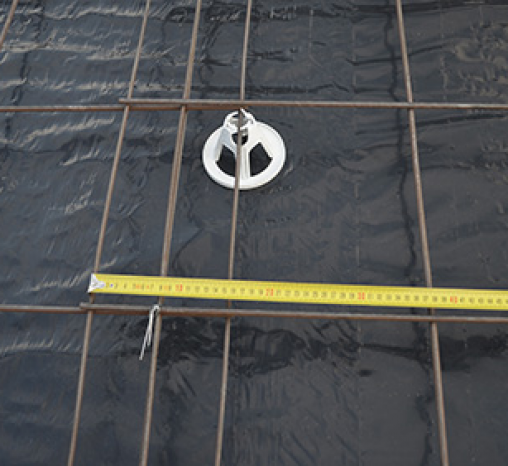
To ensure good performance, you need to make sure sheets of reinforcing steel mesh are properly lapped to prevent a crack from forming and the slab (or other concrete member) from failing, at the lap joints.
This originally appeared in Codewords newsletters prior to January 2014. It was updated in January 2026 to reflect the requirements of Verification Method B1/VM1 Second Edition (issued in July 2025) and the introduction of the Building Product Specifications.
Following the series of Canterbury earthquakes and the damage to concrete-slabs-on-ground, measures were introduced to the Building Code’s Acceptable Solution B1/AS1, to increase the resilience of concrete slabs on good ground against earthquake shaking.
One of these measures was the requirement for Grade 500E reinforcing mesh fabric, as explained in mesh for reinforcement of concrete slabs on ground.
Reinforcing steel mesh fabric is used (with and without other reinforcing steel) in concrete members such as floor slabs and walls. It resists forces and displacements induced by gravity loads, earthquake shaking, ground movement and shrinkage strains. Reinforcing steel mesh fabric is made from wires that are welded together to form sheets.
Laps need to be able to develop more than the elastic yield strength of the reinforcement, otherwise sudden failure can occur at the lap. This may be achieved either by following the Building Code acceptable solutions and verification methods, or by an alternative solution proposal.
Building Code acceptable solutions and verification methods
Verification Method B1/VM1
Welded steel mesh must meet the requirements of steel reinforcing standard AS/NZS 4671:2019.
Verification Method B1/VM1 cites the concrete structures (design) standard NZS 3101:2006, which provides two methods for determining the splice (overlap) length of the welded wire fabric (mesh). Both methods will produce a lap that is at least as strong as the characteristic elastic yield strength of the longitudinal wire that is being lapped. These methods can be used for plain or deformed mesh, though the amount of overlap required may differ and must therefore be calculated in accordance with NZS 3101.
Using two cross wires for anchorage: Clause 8.7.6(a) of NZS 3101 requires a minimum lap of one mesh space plus 50 mm (and not less than the greater of 150mm or 1.5 times the development length – see clause 8.6.8.2). This relies on a cross wire weld developing in shear half the elastic yield strength of the largest mesh wire at the joint.
Straight lapping of mesh wires: Where cross wires are ignored or are not present within the lapped length, and the lap is a contact or near contact lap splice, clause 8.7.6(b) of NZS 3101 requires a minimum lap of the development length, which shall not be less than 200mm (see clause 8.6.8.3).
Acceptable Solution B1/AS1
B1/AS1 cites the Building Product Specifications for the applicable steel reinforcing standards including AS/NZS 4671:2019. B1/AS1 also modifies the citation of NZS 3604:2011 with additional requirements for reinforcement.
Alternative solution proposal methods
Lap lengths can be varied from the above, if sufficient testing is carried out.
Testing must include lap length tests and cross bar weld strength tests, and must specify all the relevant test parameters, such as the minimum 28-day concrete compressive strength and wire mesh fabric properties (verified as meeting or exceeding AS/NZS 4671).
The assessment should also look at the potential impact on concrete crack formation at high stress levels. In other words, even if the lap length test performance is adequate, additional lap length allowance is still required, to limit crack formation resulting from the loss of reinforcement bond.
Such testing and assessment should be accompanied by a technical opinion from a building professional such as a chartered professional structural engineer.
For these alternative solutions, the information should be presented in such a way that building control officials can easily see how side and end laps are made, and that the basis for them is different from those laps specified in the Building Code acceptable solutions and verification methods.